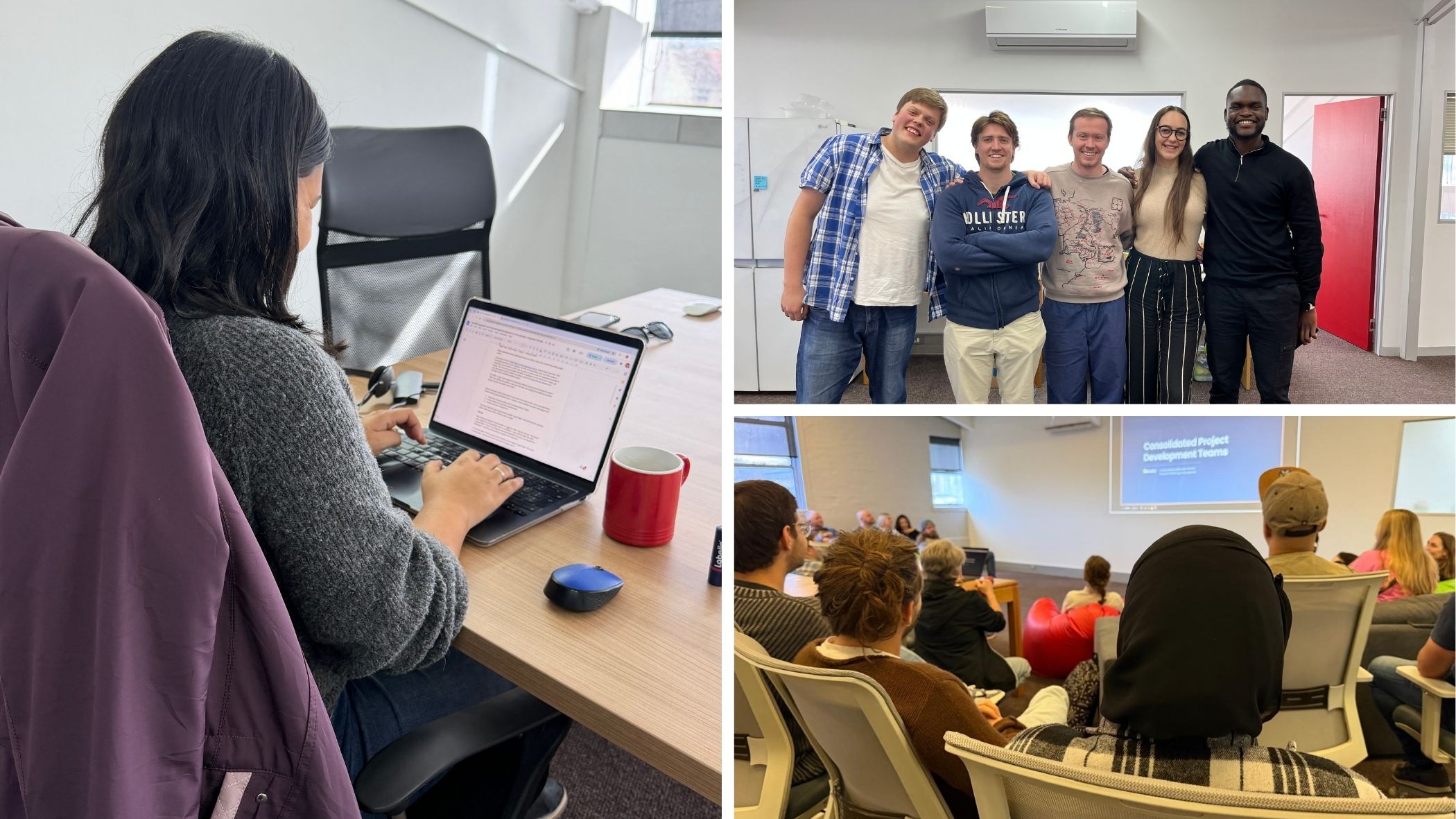
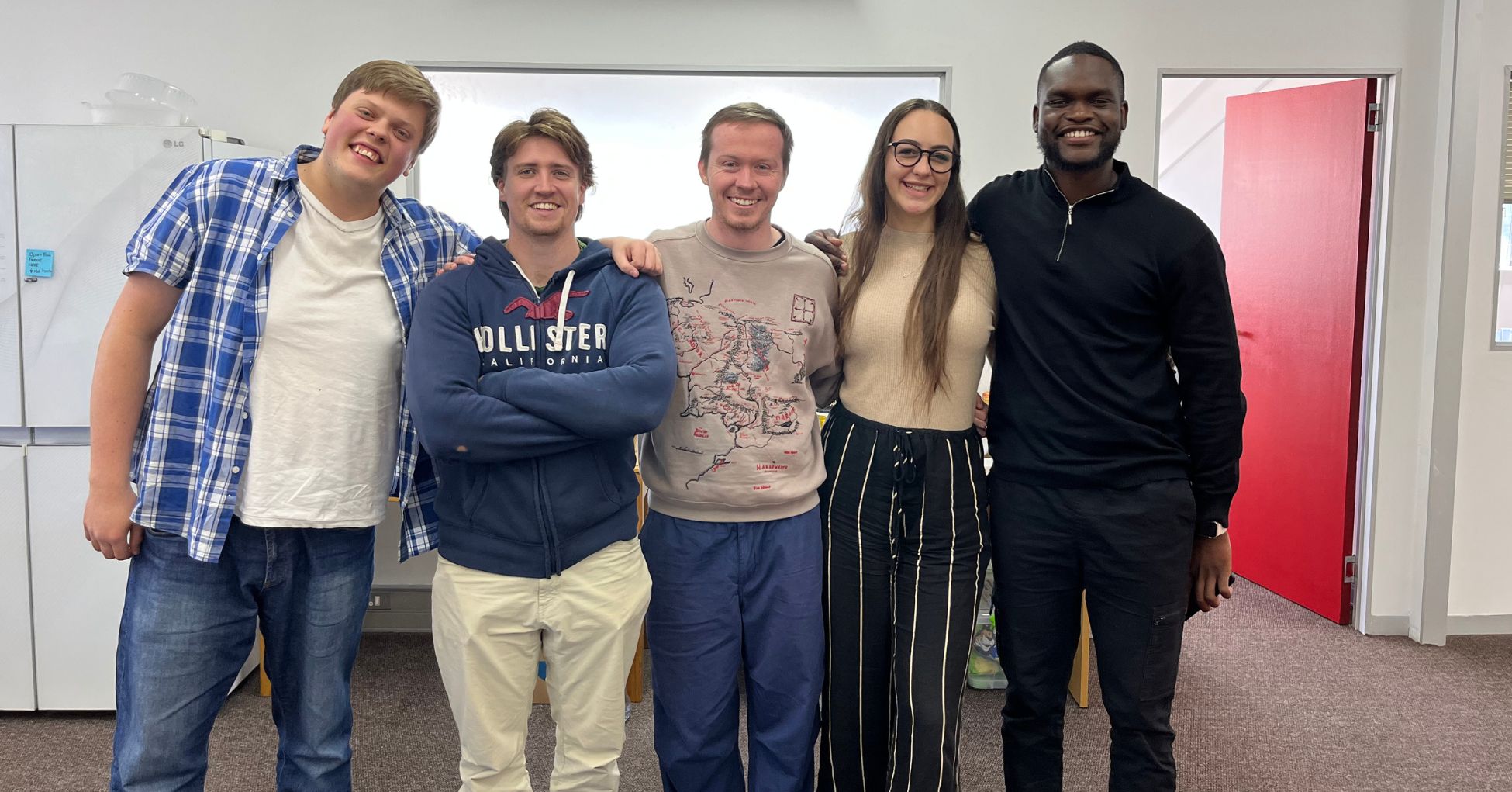
In January 2026, ten people started a six-week software development programme at KRS. They all came from different places and backgrounds: a retail career, two final-year degrees, a front-end web course, two years of job searching. At the end, KRS offered five of them full-time junior developer roles: Charlize Fourie, Liam Joubert, Ryan Kok, Tinashe Nganadange, and Aidan Strydom.
Now several months in, we checked in with them on what the transition from intern to junior developer was really like, how it compared to what they expected, and some of the things they’ve learned along the way.
Before it all started
One thing all our junior developers could agree on is that none of them arrived feeling ready.
Charlize had just written her last exam for her BSc in Computer Science and expected to feel “unequipped and out of place.” Tinashe had finished his degree at Wits and had just moved to Cape Town. That meant a new city, no network, and his first professional environment.
Ryan had been job-hunting for two years and jumped at the opportunity to join the programme. Liam had spent four years in retail and wanted to make a complete career change into software development. Aidan was coming off a front-end web development course and had no frame of reference for what a real working environment would feel like.
Despite the nerves, they all showed up anyway, and the anxiety most of them carried didn’t last long.
The first week of a software development programme
Charlize’s first week exceeded her expectations. She found the programme practical from day one, and the problems they solved mapped directly to the kind of work they’d face in the role.
Ryan was introduced to pair programming on his first day. He’d never done it before and assumed it would be uncomfortable, but the collaboration came easily and set the tone for how the rest of the programme would run.
Tinashe found the welcome genuine.
“Everyone was welcoming. I was provided with all the resources I needed, and I quickly built friendships with the other interns.” – Tinashe Nganadange
Aidan found his first week more manageable than expected, largely because of the support around him.
Liam expected to be the odd one out as the oldest in the group and the only one without a tech background. But he soon found out that they were all just figuring it out together, and that made the harder moments easier to manage.
When the technical challenges hit
Getting comfortable in a role is one thing, but real growth starts when the work pushes past what you already know.
For Charlize, that moment came towards the end of a project when a task that looked simple, turned out to be anything but. For her, it was insightful to learn about the impact of a seemingly small change, and that technical skills must be coupled with good planning to complete a task.
Liam hit a task in his third week that felt impossible, but thanks to training in AI-accelerated development and support from his team, he completed it ahead of schedule. Aidan restarted a complex piece of work multiple times before finding an approach that held. Ryan was handed a legacy system conversion in a language he’d never used and had to learn by reading before he could contribute by writing.
For Tinashe, the stretch was less technical. About a month into his full-time role, he was asked to lead support for his team, an experience that accelerated his learning faster than he ever thought. His people skills have improved, and he is now comfortable being outside his comfort zone.
What made these challenges manageable was the support around them. Senior developers, project leads, and teammates were always available to help work through problems as they came up.
The support behind the learning curve
That support didn’t happen by accident. The software development programme was designed with mentorship built into the structure, led by KRS Project Director Alain King and HR Director and Head of People, Ayesha Bagus.
While Alain created an environment that encouraged learning and growth, Ayesha made sure the transition into a professional environment was well managed, from easing early nerves to handling the admin that comes with starting a new role.
But what came through most clearly is that mentorship at KRS extends beyond the people running the programme. Aidan stressed that the support came from across the company, while Charlize described it as guidance every step of the way.
Tinashe found that his wider team was just as invested in his growth as the programme leads were, and that the reassurance he received early on had a direct impact on his confidence and performance. Ryan put it simply: supportive from all sides.
For a group of people navigating their first months in the industry, that consistency made all the difference between learning under pressure and just being under pressure.
As we’ve explained our perspective on junior developer skills in the AI era, how new developers are supported early on has a direct impact on the kind of professionals they become.
“Everyone in the company has been where I am at some point and has really tried to help me, pointing me in the right direction and seemingly always knowing the right thing to say.” – Aidan Strydom
Making mistakes early in your career
Starting a new career means getting things wrong in front of others. How an organisation responds to that determines whether mistakes become something people learn from or something they learn to hide.
Charlize admitted that, initially, she took on too much too quickly and struggled to maintain a healthy work-life balance.
Liam broke the main branch by pushing code that wasn’t ready, more than once. Aidan walked into a progress report presentation without realising that explaining technical work to a non-technical audience is its own skill entirely. Ryan assumed he knew more than he did, and Tinashe held back from asking for help when he should have spoken up.
The feedback they received was direct. But it came from a place of investment, not judgment.
“I learned how important it is to keep my mind fresh for the work we do, as taking on too much can negatively impact the quality of the work we produce.” – Charlize Fourie
The culture they didn’t expect
There’s a difference between what a company says about its culture and what you actually experience once you’re in the room. For most of the group, the experience was surprising.
Charlize noticed the genuine care across the whole organisation. Ryan had expected a software company to be formal and corporate, and found the complete opposite. Liam was struck by how open and honest the feedback culture was.
Aidan came from a previous environment where productivity meant working at your mental limit. He noticed the work felt calm at KRS, not because it was easy, but because it was well understood and well managed. As we’ve written about in our thinking on inclusion in tech, the way teams operate has a direct influence on how individuals develop over time.
Getting the full-time offer
Being offered your first full-time role in a new career carries a particular weight.
Liam was ecstatic. Ryan described a great sense of relief after years of searching. Charlize felt a mix of gratitude, surprise, and excitement, alongside a bittersweet awareness that moving forward meant saying goodbye to the interns who weren’t continuing.
Tinashe had really been looking forward to the possibility of joining KRS full-time and was excited to make it official. For Aidan, it was about trust, knowing that the effort KRS had put into training him was matched by confidence in what he could contribute.
“This job has the potential to be life-changing for me. I really needed a win this year.” – Liam Joubert
Life as a junior developer at KRS
While the software development programme ended months ago, the learnings have only just started.
All five are now working within KRS project teams on real delivery, and all of them are clear about where they want to grow.
Charlize is focused on deepening her understanding of the fundamentals and becoming a stronger part of her team. Tinashe is driven by the idea of being trusted with real responsibility and known for quality work.
Liam is inspired by his current project and the people around him, while Ryan is sharpening his technical skills and building stronger relationships with colleagues. And Aidan is keeping it simple: be better tomorrow than he is today, and make more friends along the way!
KRS is a Cape Town-based custom software development company. To find out more about careers at KRS, visit krs.co.za/careers.